Architecture
Understand dependencies, requirements, and operating constraints. Ground design decisions in infrastructure facts and engineering knowledge.
Knowledge & intent
Silas by Dynecon
Silas is an agentic operating system purpose-built exclusively for infrastructure architecture, engineering, and operations. It brings specialist agents, operational context, platform-native tools, and governed execution into one system for designing, changing, and running infrastructure.
One domain. Three connected disciplines.
Silas’s agentic OS organizes reasoning, knowledge, tools, and execution around infrastructure work. Its scope shapes the context agents need, the systems they connect to, and the evidence operators use to judge an outcome.
Understand dependencies, requirements, and operating constraints. Ground design decisions in infrastructure facts and engineering knowledge.
Knowledge & intentTranslate intent into candidate plans through specialist agents and platform-native integrations. Compare proposed changes with current state and validate the execution path.
How the system worksInvestigate conditions, coordinate bounded work, and retain evidence for review. Keep changes connected to approval, verification, and the people responsible for the environment.
Execution controlsSilas connects agents, knowledge, integrations, and execution controls into a shared operating layer for infrastructure teams. Engineers work through conversational interfaces; Hive coordinates tasks and shared context, Gandalf preserves operational memory and reusable knowledge, and Edge connects platform-native tools. Praxis provides a governance framework for the standards and engineering workflows that guide agent work.
The same infrastructure facts and specialist expertise can inform individual engineering work and coordinated team workflows. That shared foundation keeps architecture decisions, engineering changes, and operational evidence connected.
Explore the shared foundationsThe experience behind Silas
Silas draws on decades of combined subject-matter expertise across infrastructure engineering, operations, and business leadership.
Dynecon’s consulting work and the Network Sciences Platform helped shape the original thinking behind Silas: connect what engineers know with what infrastructure is doing, then turn that understanding into repeatable, accountable action.
The Network Sciences Platform is one of the ecosystem’s data ingestion points. It brings infrastructure facts and operational context into the knowledge foundation used by Silas, its AI engine, and Hive.
Silas builds on an underlying platform and engineering foundation battle-tested on some of the world’s largest networks. That operational experience informs the agentic OS: its context, workflows, and approach to controlled execution.
Discovery, configuration, topology, and dependency information help describe the environment as it is understood. Alongside other inputs, the Network Sciences Platform supplies the operational evidence that grounds agent reasoning in the systems being managed.
Subject-matter expertise provides the interpretive context: what the data means, which relationships matter, and what a proposed change could affect. Silas and Hive bring those facts and that knowledge together when investigating a question or developing a plan.
The Network Sciences Platform established a way to turn specialist knowledge into repeatable engineering workflows. Silas carries that lineage forward into an ecosystem of agents, operational context, and governed tools.
The aim is to bring technical reasoning and operational judgment into the same conversation—connecting a proposed action to its infrastructure dependencies, the people responsible, and the business outcome it serves.
Under the hood
The published Silas architecture brings together four layers, from the engineer’s interface to the infrastructure execution path.
Desktop, CLI, and Slack bring natural-language workflows into the places engineers work.
A coordinator breaks work into tasks, routes it to specialists, and assembles the results.
Platform-specific MCP modules connect F5, AVI, Splunk, Grafana, and ServiceNow to agent workflows.
Async device access, messaging, and telemetry support the operational layer.
Explore the published Silas architecture for implementation details.
Control is part of the product
Silas’s published governance model includes signed prompts, approval queues, credential handling, and execution traces. These controls connect an agent’s work to the people responsible for the environment.
Our operating approach keeps goals, acceptable risk, and outcome review with people. Coordinated agents carry out bounded tasks and return evidence that supports the next decision.
Praxis addresses the engineering guidance behind that work: who authors the standards, how they become reusable agent artifacts, and how proposed work is reviewed. Execution controls govern individual actions; the Praxis framework defines how engineering work should proceed.
Explore Praxis governance Explore the people and agent loops Read the technical detailLLM governance / Infrastructure decisions
Built by architecture and operations experts, Silas integrates Reinforcement Learning for Calibrated Decisions (RLCD) into its approach to agentic governance and critical infrastructure interaction. Models shaped by Reinforcement Learning from Human Feedback (RLHF) support the conversational experience engineers use to express intent, explore options, and understand results.
RLCD targets structured decisions with probabilities that reflect observed outcomes. In infrastructure workflows, that information supports risk-aware routing: proceed within an authorized scope, gather more evidence, or escalate for review. Decision thresholds belong to the task, its consequences, and the operating policy.
RLHF uses human feedback during model training to improve alignment with human preferences. In Silas, this supports helpful dialogue, instruction following, and explanations as operators work with agents across their infrastructure landscape.
Praxis supplies engineering standards and review workflows. Hive coordinates the work. Policy checks, scoped permissions, human approvals, and outcome verification govern infrastructure actions. Calibrated confidence informs those decisions; authorization remains an explicit control.
Explore PraxisPraxis by Silas
Praxis connects the standards architects author to the agents, requirements, reviews, and decisions that shape engineering work. It gives the Silas ecosystem a governance workspace grounded in a shared, versioned canon.
Explore PraxisPlatform mechanics
Hive represents complex work as a directed acyclic graph. Independent tasks can proceed in parallel; dependent tasks wait for their prerequisites. A coordinator combines specialist results into a response.
Explore Hive in the architectureThe Edge layer manages platform-specific MCP servers. Tool discovery and proxying connect the agent to native APIs without putting vendor-specific behavior into every workflow.
Read the integration architecturePrompt governance defines agent behavior. Execution approval controls sensitive actions. Permission settings constrain filesystem, command, and network access. These are distinct controls with different responsibilities.
Explore execution controlsJob tracking and traces connect a request to tool activity. The architecture includes NATS messaging, authenticated connections, credential resolution, and sanitization of sensitive data.
Explore the operating modelKnowledge, coordination & intent
Memory is a founding principle of Silas. Gandalf connects operational facts, technical knowledge, task history, and lessons learned so agents can carry context across work and bring prior experience into the next decision.
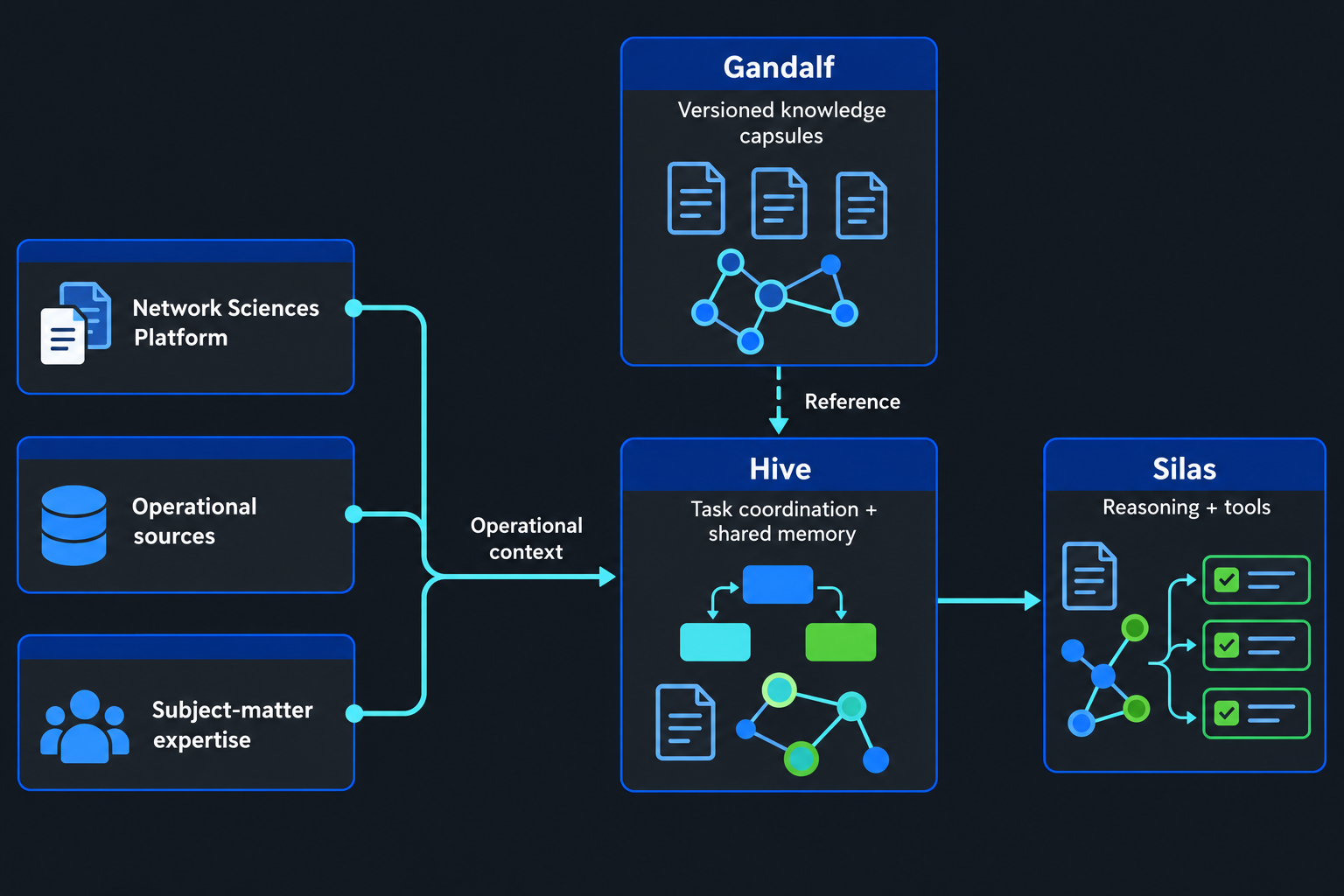
Short- and long-term memory connect tasks, manifests, outcomes, conversation turns, user interactions, and technical references. Contextual retrieval brings relevant history and lessons into the current task, alongside versioned knowledge capsules.
Task graphs express dependencies, capability-based routing selects agents, and shared memory records decisions, patterns, and context. Approval workflows provide a point for human decisions.
Desired-state declarations become plans with configuration differences and policy results. The F5 stack implementation includes plan history, state tracking, and execution locking.
Gandalf / Memory & adaptation
Silas treats history as an operational resource. Gandalf connects short-term working context with long-term experience, supporting deep, contextual retrieval across accumulated history while keeping startup and the active context window focused.
Retrieve prior work with its intent, decisions, manifests, outcomes, and relevant interactions. The memory model preserves the context needed to understand a result and apply a lesson without loading the entire operational history into every agent session.
Gandalf serves as a living source for learning from technical knowledge and operational experience. Model adaptation includes fine-tuning and weight updates as infrastructure, underlying models, and the demands on contextual memory change.
Evaluate task recall, contextual relevance, retained lessons, and technical-document retrieval against representative work. Compare model and retrieval changes against baselines, review regressions, and validate improvements before promotion. Capturing an interaction and approving it for training are separate decisions.
Connect learning to Praxis governanceVendor packs & blueprints
The vendor-pack model brings a storefront and blueprint library together around vendor- and community-driven Hive implementations. Customers can shape their Hives around the infrastructure they operate and the vendor ecosystems they choose.
Reusable blueprints describe automated Hive setup. Platform-specific knowledge and implementation details belong in those packs, allowing Silas to remain vendor-agnostic as the ecosystem grows.
This carries forward a principle from Dynecon’s consulting work: shape the solution around the customer’s environment and needs. The software should preserve that freedom of choice.
The next move
We’ll work with you to find where AI and automation can make a practical difference.
Start a conversation