The learning loop
Engineers and business owners decide which problem matters, what success looks like, and which constraints apply. They review behavior, service outcomes, and failures before changing the next task or its operating guidance.

AI-led infrastructure automation
Silas is the agentic OS behind our approach, purpose-built for infrastructure architecture, engineering, and operations. Its shared operating layer connects specialist agents, operational knowledge, and native tools to the environment they need to understand and the checks they must pass before anything changes.
Direction, execution & feedback
Useful automation connects two loops. People choose the outcome and acceptable risk. Agents investigate, prepare, and execute within the boundaries of the task. Evidence brings the result back to the people responsible for the environment.
Engineers and business owners decide which problem matters, what success looks like, and which constraints apply. They review behavior, service outcomes, and failures before changing the next task or its operating guidance.
Agents assemble context, decompose work, use scoped tools, and return a plan with evidence. Checks, approval boundaries, execution records, and verification connect that work to an accountable decision.
How Silas coordinates the work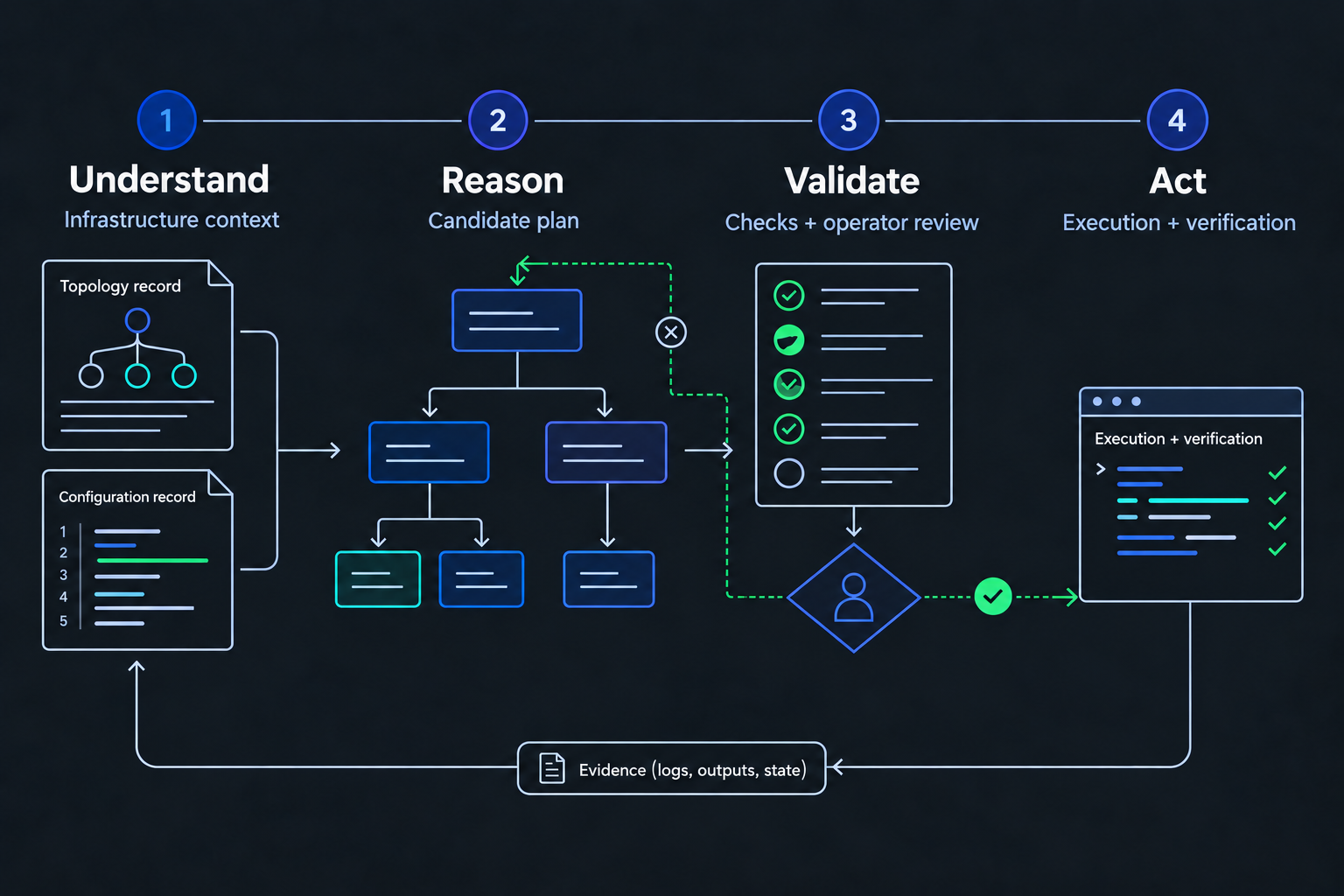
Connect topology, configuration, dependencies, and intent. Give the agent evidence it can reason from.
Context before conclusionsThe technical boundary
Build from configuration, topology, service dependencies, and operational telemetry. Expose bounded tools through interfaces such as Model Context Protocol, with access appropriate to the task.
Explore the context foundationKeep proposed changes separate from the running environment. Compare intended state, validate syntax and policy, and identify assumptions that need operator judgment.
Explore intent and planningDefine which actions require approval, capture what is authorized, and verify the result against explicit criteria. Preserve the evidence and a recovery path.
Explore Silas controlsAn engineering framework
Model choice is one part of the system. These questions guide the engineering around it and apply across Silas’s four architecture layers: interfaces, Hive, Edge, and execution foundations.
Use relevant operational facts, provenance, and reusable expertise. Check freshness and gaps instead of treating a larger context window as a substitute for better evidence.
Define task dependencies, tool feedback, stop conditions, and escalation. Keep specialist results concise enough for the coordinator to reconcile them.
Use deterministic checks for exact rules and structured state. Evaluate model-assisted investigation and explanation against the task’s quality, latency, and resource requirements.
Make permitted tools, credentials, scope, and review requirements explicit. A useful answer and authorization to change infrastructure are separate decisions.
Maintain representative tasks, expected outcomes, and known failure cases. Compare changes to instructions, knowledge, tools, or models against a baseline before promoting them.
Praxis provides the governance framework for translating architect-authored standards into agent roles, conventions, rules, and review workflows. Its compilation model gives that guidance a structured source.Explore Praxis in the Silas ecosystem
Proposed improvements need evaluation and review before adoption. Related research, includingMicrosoft Research’s SkillOpt, illustrates why proposed skill changes need validation before adoption.
A practical adoption path
Bring systems of record, configuration, and service relationships into a shared context. Start with the facts needed for a useful decision.
Investigate requests, explain differences, and prepare reviewable plans. Evaluate the result while the engineer directs the work.
Expand recurring or proactive work only after scope, success criteria, permissions, resource limits, and escalation are explicit. Verify the outcome before widening the boundary.
Ownership remains human. For a personal workflow, team runbook, domain task, or shared service, name an accountable owner and define the agent’s role, permitted context, tools, budget, and stop conditions. Use these requirements to define the deployment’s delegation boundary.
The next move
We’ll work with you to find where AI and automation can make a practical difference.
Start a conversation